
Handmade in a Mass-Produced World
Listen to the story in the artist's voice
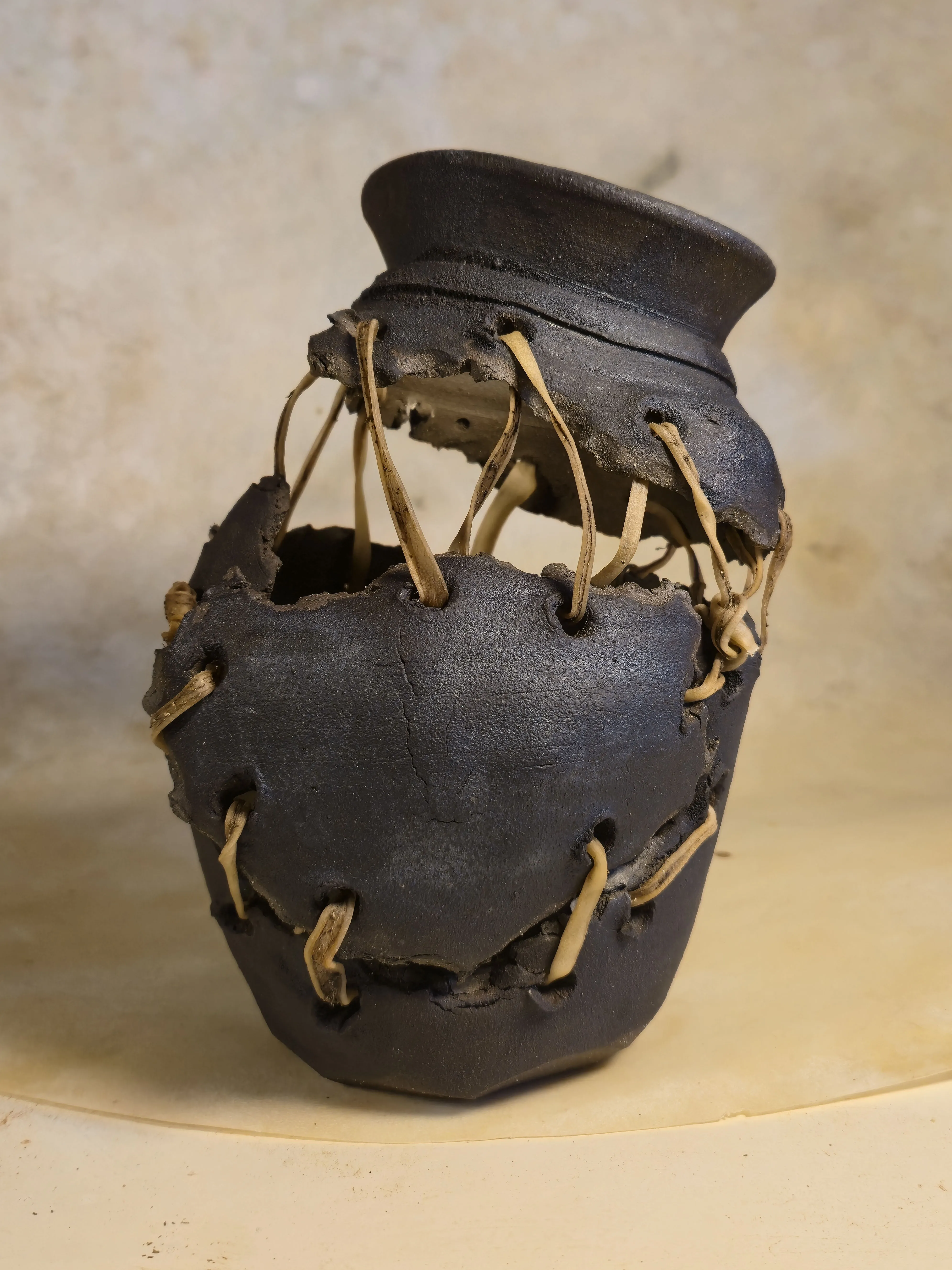
At a show a few weeks ago, a woman stood in front of one of my Holding pieces and teared up. She told me she felt seen. She’d been through things, and the piece held something she recognized. That’s what the whole Holding series is about: how we hold ourselves together through everything life throws at us.
Later that same day, another woman walked up to the same piece and told me it looked like poop. She said it was vile and that I should take it out of my booth immediately.
I laughed so hard. Honestly, it was the highlight of the whole weekend. Holding is the first series I’ve made since moving from functional potter to sculptor, and here was a piece that moved one stranger to tears and another stranger to insult it to my face. Either way, it got to them. Art is supposed to make you feel something, and it doesn’t have to be something good. I left that show knowing I was headed in the right direction.
I don’t think a mass-produced object can do that. And I’ve been trying to put my finger on why.
It starts in the dirt
Some of it is simply what goes into a piece. In ceramics you can go as simple or as crazy as you want. The simple route is commercial clay, commercial glaze and an electric kiln. A cup takes five or six minutes to throw, a couple of days to dry and a few minutes to carve. Then it gets two firings: one to make it sturdy, and one with the glaze that closes up the clay so it’s food safe and won’t seep water.
Then there’s the crazy route. This summer we dug our own clay out of the ground and hiked a mile to collect glaze material, packing out about 60 pounds each on our backs. That clay gets dried, smashed, soaked, sieved, dried again, mixed with temper and wedged. It’s brutal, physical work, and you haven’t made a single thing yet.
I love it anyway. Working with wild clay and materials I collect myself means more testing, more variation and more unpredictability, and that’s the point. For me, ceramics is about letting go of perfection and having a conversation with the material. Nobody else dug from the exact spot I dug, so nobody else has that clay body or that glaze. Right now I’m working with dirt from Michigan, Illinois, Arizona and New Mexico. I’m traveling the country collecting dirt and making things out of it, which is still kind of wild to me.
The best way I can explain it is a garden versus a TV dinner. A lot of the time, commercial clay is the TV dinner. You stop thinking of it as something that came out of the ground and start thinking of it as an art supply.
Then the fire
Wood firing takes it even further. I’ve done wood fires for several years. Each one is four days of stoking every six minutes or so, starting from a simple friction fire and climbing past 2,400°F. Then the kiln takes about two weeks to cool down before you see what you’ve got.
After all that, the material doesn’t feel like a product. As makers, we respect it, because it’s part of us. It isn’t just extraction and dollars. I come at this from an animist way of seeing the world. I strongly believe that every rock, stone and plant, everything, has its own life force. So the clay isn’t just stuff to me, and I believe the material in a finished piece responds to the respect you bring to it. It’s also why I don’t make tight, templated work. The imperfections are where a piece shines, so I let the variance come through. People feel it, even if they can’t say why.
Living with things that have a story
I’ve lived off-grid for around 11 years. I built my own home, I’ve built earthbag homes, and I haven’t rented or lived in a regular house that whole time. Put me in a square room with drywall and MDF garbage furniture and I can feel my body start shutting down. It doesn’t want to be there.
I think a lot of us have leaned on convenience so hard that we’ve traded the beauty in our lives for the cheapest crap we can find. I’m not perfect about it either. But I find that things that are a little rougher, a little broken or repaired are really beautiful. That’s a big part of why I love the Fixers Manifesto. It’s the idea that a broken or repaired thing is a beautiful thing, and that fixing something gives it more life instead of less. You can see it all through the Holding series. Every repair tells a story.
That’s what bothers me about a mass-produced world. Nothing has a story and nothing has a life, so nothing really has value.
The cup in the cabinet
Here’s where it all comes home for me. I have a lot of cups from potters, artists and friends, and when I reach into the cabinet, they’re all different. Each one has its own purpose and its own ritual. When I pick one up, it’s the Virginia cup, or the James cup, or the Sid cup, and for a minute I’m with that person even though they’re not there.
I made functional pottery for a long time and sold hundreds and hundreds of mugs, cups and dishes. Things I touched are now sitting in hundreds of homes, and that’s pretty special to me. It was never just about the dirt. It’s about the collaboration between the dirt and the maker.
Where to start
If you’ve never bought handmade art, try it. If you have $30 to spend, go to a local art market, find a piece you love, ideally one you’ll use every day, and bring it home. You’ll have something nobody else has, and you’ll be supporting someone brave enough to make a living from what they love.
Start wherever you can, whether that’s $10, $100 or $1,000. Every purchase is special to the artist you’re buying it from, even when it would mean nothing to a big corporation.
If you let yourself, you’ll feel the difference.